Rather than wheel out a polished set of categories and theories about form and meaning let’s instead try imagining a situation where some form of representation is required.
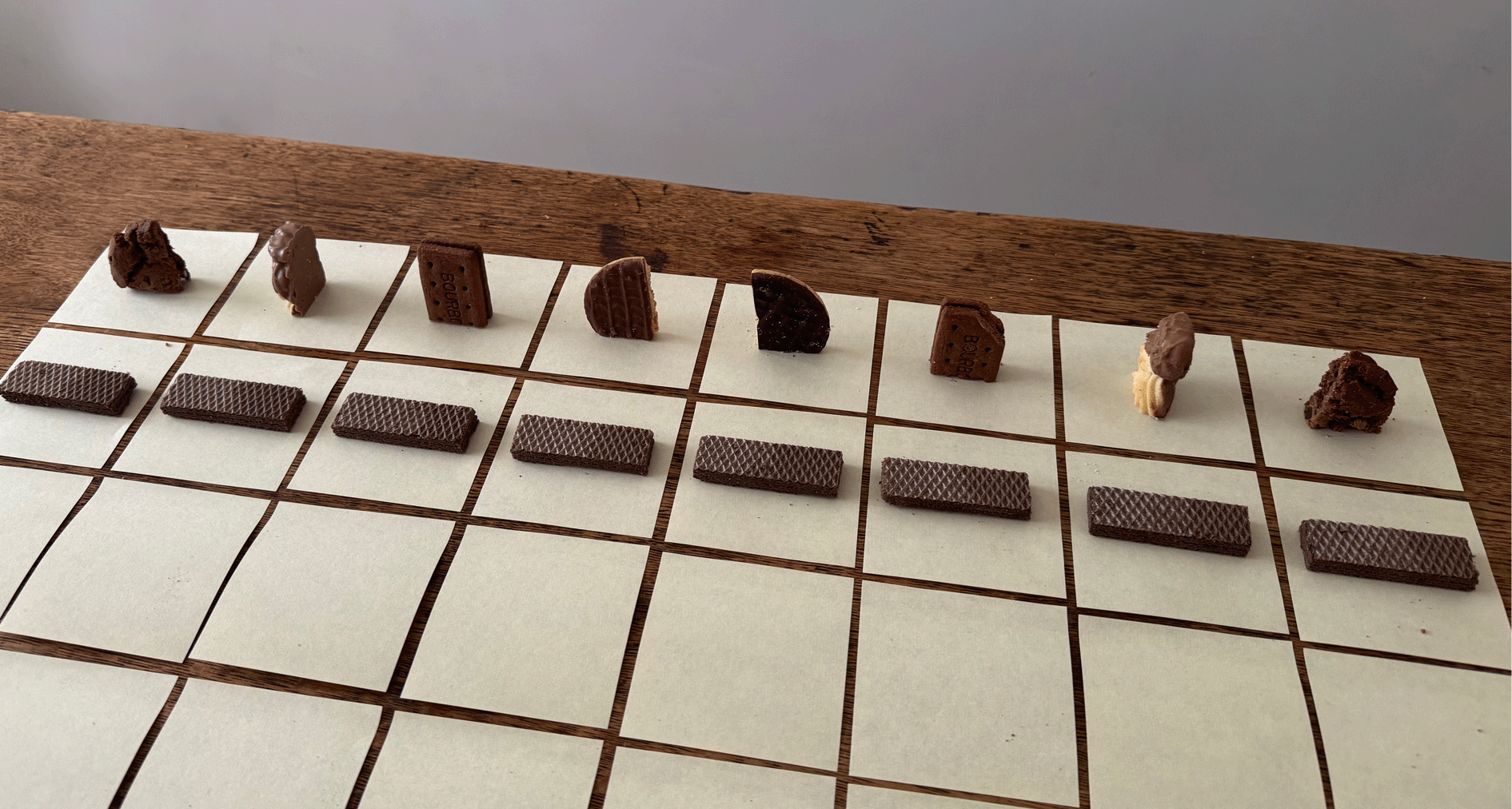
Imagine a school staff training day. After the last tea break of the day a huge number of drained cups, plates, and left-over cakes and biscuits remained. As usual the event was vastly over catered and there were many untouched biscuits left behind. Two school friends had been recruited to help with the catering, but after all the dirty crockery had been cleared away there was still an hour or so before home time. The teachers had told the students to ‘help themselves’ to the leftover biscuits and there were whole tins of assorted biscuits leftover. They counted at least 32 different styles of biscuit.
Being keen chess players one of them remarked that ‘if only they had a chess set’. At this point a connection was made between the 32 pieces on the chess board and the 32 different types of biscuit. There are enough biscuits types to individually distinguish between each individual chess piece on both sides. So why not use biscuits to stand for chess pieces? Student A makes a list so that every piece on the board has its own unique type of biscuit.
But they quickly realise that this arrangement places an incredible cognitive load on the players, trying to memorize all the different biscuit/chess piece combinations is impossible, even more so if the game was to progress and the pieces are moved away from their home positions and juxtaposed with pieces from the other side.
The different biscuit types, in their initial thinking about the biscuit chess pieces, provide a range of forms—the biscuits—that are paired with a set of meanings—the different chess pieces. There is very little that I can think of that links one biscuit to one chess piece. At first the biscuits have been rather randomly assigned to the different chess pieces, so they don’t look the way the chess pieces look, they don’t have any value that equates to the rankings of their chess piece partner, and they don’t taste or sound like their paired chess pieces either. To all intents and purposes therefore this is an arbitrary association between biscuits and chess pieces. Because it is arbitrary, there is nothing that can be inferred from just the form of the biscuit that will lead you a conclusion about which chess piece it represents on the board. The designated chess piece to biscuit associations have to be learned and remembered. And this is something of a challenge for our biscuit rich chess players. An arbitrary association between a representation and the thing it represents is referred to here as a symbol.
Thankfully, one was a lover of bourbon biscuits and noticed that there are six biscuit types with chocolate—couldn’t these be used in some way to represent the black pieces while the white biscuits could be represented by other biscuit-coloured biscuits? But then each set of pieces needs 16 not six different types. But hang on; if we focus on the types of piece rather than on each individual piece, could not six the chocolate coloured biscuits types cover everything necessary: king, queen, bishop, knight, castle/rook, pawn.
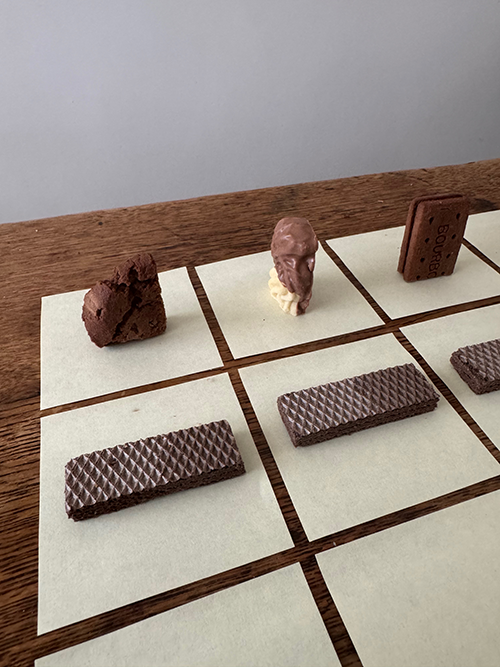
Now the relationship between the forms (the biscuits) and the meanings they represent (king, queen, bishop, knight, castle, pawn, both white and black) has changed. The forms that the students chose to represent the chess pieces are motivated not arbitrary. The darker biscuits stand for one side in the game (the ‘black’ side), this is a tone for category metonymy (see Parts and Wholes); the tone (in this case either darker or lighter) stands for the membership of a category (the two sides in the game). We are so used to thinking about the white and black pieces in chess that we might miss that this is already metonymic; where the colour of the pieces stands for all of the pieces belonging to one player. Here, one aspect of the chess pieces (whiteness or blackness) stands for the whole. For the biscuit chess pieces our biscuit-chess players simply recruited this metonymic relationship.
The point is though that the biscuit representations of the chess pieces are no longer completely arbitrary (symbolic), but are also motivated (in this case metonymically). We can no longer just choose any biscuit to represent a particular piece we must first ensure it is the correct colour.
But they do not stop there. Of all the biscuits that are in the staff room which, they wondered, is the most appropriate for the pawn? Luckily there is a rectangular finger biscuit made of wafer, and there are both plain and chocolate versions. These seem to be good candidates for the pawns. One of the players places the rectangular pieces on the board parallel with the ranks because this reminded them of diagrams of battlefield formations seen in history books. The other player though, aligned their rectangular biscuit-pieces with the files since this is the direction in which the pieces move. There didn’t seem to be a right and wrong here and when you saw the pieces on the board this led you somehow to the logic of why the pawns where placed the way they were. Seen together it felt like one was in attack mode and the other in defence. Maybe the player that went first should align their pieces with the files rather than the ranks because they are opening the attack…?
It was pleasing to discover that many biscuits come in both chocolate and plain versions. For the castles the rough texture of cookies seemed somehow reminiscent of the stone work of castles. For the knight and bishop the Viennese selection was something of a find. The milk chocolate dipped Viennese finger was perfect for the knights on both teams since they could be stood chocolate side up or down depending on whether they were the black or white knights. They decided that the kings and queens, and the major and minor pieces should be stood upright (which with some biscuits required a little careful cutting), these now stood above the pawns in a similar way to which most chess sets are organised. The final two pieces, the king and queen, were formed from milk chocolate and dark chocolate digestive biscuits on the black side and a plain digestive and rich tea biscuit on the plain side. These had to be carefully cut into quarters so they could stand up.
The board was made from Post-It™ notes, there was only one colour which was something of a problem. In the first game, although they struggled a bit since all the squares were the same Post-It note colour they found they could manage. And besides this, there seemed to be some advantages to playing with biscuits, since when check mate was called the losing player, instead of laying the king down, offered it to the winner who solemnly devoured it.
After one game, there was another improvement to be made; one of the players realised that the solution to the lack of white and black squares on the board was simple, and removed every other Post-It note from the table creating the familiar chequerboard effect.
So what representational strategies emerge from this rather silly and contrived story about biscuit chess?
The reason for working through this imagined story is to engage with representation as it is created rather than retrospectively. This is the view on representation that, yes we have as designers, but also is the view that all of us adopt in the moment, as we try to find a way of representing our ideas. There is a danger that discussions about representation only look at representation from the perspective of what some already existing thing represents, that is, from the perspective of those that consume representations. While this is a perfectly valid approach we should not ignore the perspective concerned with the making of those representations that have yet to exist. From the point of view, that is, of those that create them. From this perspective representation is not already fixed and established (in terms of thing x standing for thing y), it has yet to be resolved and is dynamic. Looking at the story of biscuit chess we can see that this is a form of problem solving; we are representing something for a reason and we can only do so with the resources at our disposal. In the case of biscuit chess the resources include yes biscuits, but also the Post-It surface that passes as a chess board, and the knowledge of chess that both of the players possess. Because the resources at our disposal are sometimes limited, the creation of a representation can sometimes be opportunistic. Consequently, because the players had to use biscuits for chess pieces other possibilities emerged, for example that you could eat the king if you won the game, or that pawns could be aligned differently depending on whether you are in attack or defence.
Designers often enjoy working with limited resources, it can be a mistake to shoot for the epic if you only have the budget for a B-movie. And opportunistically embracing constraints can lead to highly creative outcomes, for those that have not seen it, check out Lars von Trier’s The Five Obstructions.
Choosing one thing to represent another in this opportunistic way also involves ignoring things. Choosing a cookie to represent a castle (or rook) requires us to ignore things about the cookie that have nothing to do with castles—how the cookie tastes for example—and concentrate on things that relate to both cookies and castles—the rough texture of cookie mix and stone. Users of a representational system built on constraints may well be aware of, and enjoy, the representational choices that are somewhat forced—for example they might ask, ‘From the biscuit-world which biscuit would I choose to represent the king: what is the “king of biscuits”’?
The question of which is the ‘king of biscuits’ introduces another complexity for there are two frames involved in biscuit chess, that of biscuits and that of chess. If we think about biscuits for a moment there are a number of different types to choose from and they can be systematically structured in any number of ways. What are the most expensive and least expensive; on a scale of 1–10 which goes best with a cup of tea; which are appropriate for an adults coffee morning and which for a children’s party; which have the richest flavours and which more bland, which are posh and which more ‘common’? There are similar, but different, systematic qualities to be found among chess pieces: which are the most powerful and which the least, which pieces represent the nobility and which the common folk, which pieces are bigger and which smaller?
Since the biscuit world is being used to represent the chess piece world it makes sense to try and find correspondences between the systematic relations found in biscuits with the systematic relations found in chess pieces. And furthermore to prioritise the chess piece relations. So we choose the biggest biscuits to represent the biggest chess pieces for example. Or we choose the biscuits with the strongest flavours to represent the pieces with the most power. These systematic relations are also motivated by the workings of our cognitive unconscious through such things as primary metaphors (which will be discussed in another essay). These capture our repeated basic experiences of the world in metaphors like size is importance. Here we use our experiences of size (the size of a chess piece for example) to come to an understanding about its importance.
In addition to these systematic relations however each biscuit will have its own more individual qualities that might also affect our decision making. The linear shape of finger biscuits were used to suggest either, the direction in which pawns move, or their pictorial resemblance to how military units are presented in diagrams of troop placements. Note that in this representation of chess, the ways that pieces move is not a systematic choice reflected in other biscuit-chess piece choices, however it could conceivably be made to be—by making biscuits so that the different chess piece moves are inscribed on their surfaces, for example.
As graphic designers we often concentrate on the visual qualities that things have to inform our creative decision making—whether the representing thing looks like the thing it represents. But in biscuit-chess the qualities used to inform our representational choices come from other sensory domains too, they could be to do with taste and touch as well as vision. They might also be to do with social qualities; in what kind of social settings are the biscuits consumed for example, and how do these reflect the social hierarchy represented by the chess pieces themselves.
There are therefore systematic qualities that tie all pieces together: big biscuit-chess pieces link to big chess pieces, the bigger the piece the more important it is, and so forth. There are also individual attributes specific to one type of biscuit-chess piece. And these attributes can link to the game of chess in any number of ways; through visual resemblance; through associations based on taste, touch, value, social hierarchy, and so on.
In some cases individual attributes are so specific to one biscuit type that they could never be applied to all the biscuits. For example perhaps one biscuit has a jam filling and none of the others do. But in other cases a particular individual attribute could be used systematically across all biscuit-chess pieces. Take the monetary value of the biscuit, for example, the players could have calculated the unit cost of each biscuit type and used this as a criteria for allocating biscuits to chess pieces; the most expensive biscuit being reserved for the king, and the least expensive allocated to the pawns. But this system would probably have clashed with the size criteria that the players intuitively decided on—after all, the size of all biscuits is not automatically commensurate with their monetary value. Some biscuit-pieces would have been smaller than another less powerful piece. There is an element of choice therefore, in terms of which attributes are used systematically and which individually.
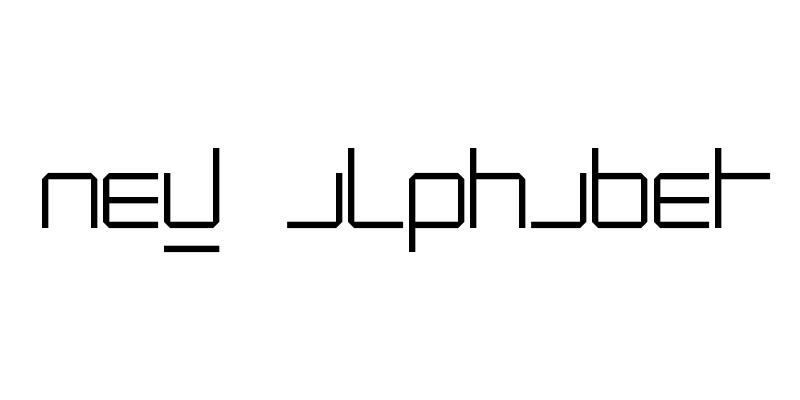
Another positive in relation to systems of representation seems somewhat counter-intuitive. Because a closed system has a limited number of elements, this can actually help users in working out what a given element in the system represents. Consider this shape.

Seen in isolation it is something of a challenge to determine that this shape represents the ‘a’ sound; it is a letter, or glyph in other words. If seen in the context of other glyphs in the same font however it is much easier to work out what this shape stands for. Yes seeing a word string gives us the context to conclude that this is a letter-form, but why is this not a j, l, i, or d? Wim Crouwel, who originally designed this typeface, was able to define a set of relationships between these very reductive forms that map onto differences between the shapes associated with more conventional letter-forms. There is one highly restrictive set of forms (New Alphabet) that maps onto a more open, but still relatively closed, set of forms (the Roman alphabet).
These issues of systematicity will be discussed in a forthcoming essay, but for now it is worth recognising that our biscuit-chess pieces similarly diverge somewhat from regular chess pieces but given the limited repertoire of biscuits available we are able to see how one choice of biscuit is an appropriate choice for one type of chess piece. If there were a limitless number of biscuit types it would be more difficult to pair a biscuit with a chess piece because there might always be another type of biscuit that we have not seen that is better suited.
One further point is worth making before concluding our discussion of biscuit-chess. These games of biscuit-chess played by our student friends are only a few expressions of the game of chess that has been evolving for over 1,500 years. At a high level the game itself may have stabilised with a formalised system of rules, and governing bodies such as the International Chess Federation to enforce them. But at a lower level—that of two school friends trying to play a game with limited resources—this does not mean that they can not improvise and find new ways to play. And once developed, their new representational system can be refined and changed further; just as when they removed alternate Post-It notes to achieve a more accurate rendition of an established chess board. This applies to how the pieces and board look, but it might also apply to how they play. They could choose to agree to not to apply the en passant rule for example, or even invent a new way in which one piece might capture another.
It is easy to think of representations as fixed immutable things, we consume representations that are already made, a part of the past world that can no longer be changed. But for artists and designers struggling to make representations each expression can be but a work in progress that can be refined and improved.
I have tried to use biscuit-chess as a way of showing how representations do not have to be uniquely, either symbolic, or metonymical, or metaphorical but can involve multiple mappings involving all three kinds of association. The black biscuit-castle/rook, for example, has the mappings of: biscuit for chess piece (symbolic), texture for material (metonymical), material for edifice (metonymical), chocolate for darker colour (metonymical), darker colour for side (metonymical) and size is importance (metaphorical).
So within the context of this essay representation is simply choosing one thing to stand for another. As soon as one thing is understood as standing for another the person engaging with the representation might consciously or unconsciously question in what ways does the thing stands for another? There are broadly three different ways: symbolically (no relation between the representation and the thing it represents); metonymically (where there are direct connections between the two aspects, where one is part of the other for example but is used to stand for the whole); and metaphorically (where the thing depicted in the representation is understood by making reference to a very different kind of thing). As I have tried to show one thing might simultaneously be associated with another in a number of different ways involving one, two or three of these different broad types of association.
It would seem to that biscuit-chess is a complex entity involving different levels of representation. At one level biscuits represent chess pieces, but at a lower level, a sub-set of chocolate biscuits represent black chess pieces, and the texture of a cookie represents the texture of stone. These are all communicative intentions on the part of the designers of biscuit-chess and are therefore representational rather than only significatory.