There is of course a rich history linked to flags as things, as well as to flag waving. That is, flag waving both as a performative act, and in the representation of such actions in painting, sculpture, photography and film. Flags in themselves represent things such as nationhood, and they can also be used as a system of communication through ‘flaghoisting’ employing the international Code of Signals, or as an aid in semaphore. They also function as participants in some dramatic historical events. The battle flag presented in a military museum, as a further example, evokes meanings that are at once residual—presenting what remains after the ferocity of battle; and subtractive—bearing witness to the ferocity of battle through what was removed. Flags can be symbolic having an arbitrary relationship to the things they represent, or motivated where there may be pictorial elements, or abstractions such as the golden fields and blue skies associated with the Ukrainian flag.
In addition to the meanings directly evoked by the flags themselves there are also many examples of flags being used as elements in more complex representations. Here there is not only the meaning of the flag itself to consider but also the communicative intention of the person making the representation; the cartoonist, artist, poster designer, and so forth, and the way in which the depiction of the flag contributes to a more extended narrative. An example of such a representation of a flag that springs to mind is Eugène Delacroix’s, Liberty Leading the People (28 July 1830). Famously, the central and elevated figure holding the flag, is a personification (as the title suggests) of liberty. She is both goddess-like and of the people, and in a similar mixing of the ideal and real, the painting depicts both real events occurring in the July Revolution of 1830 in Paris, and a more universal idea of revolution and the quest for liberty. We can be of no doubt as to the side Delacroix is on with respect to this conflict; it is the Tricolour, the French revolutionary flag, that Liberty holds aloft as she rises from the barricades over the bodies of the fallen. As an example of Romanticism there is unsurprisingly a heightened sense of emotion in the painting, when the flag in the hands of Liberty, leads the people forward as the tide of battle changes, in one final push against the oppressor.
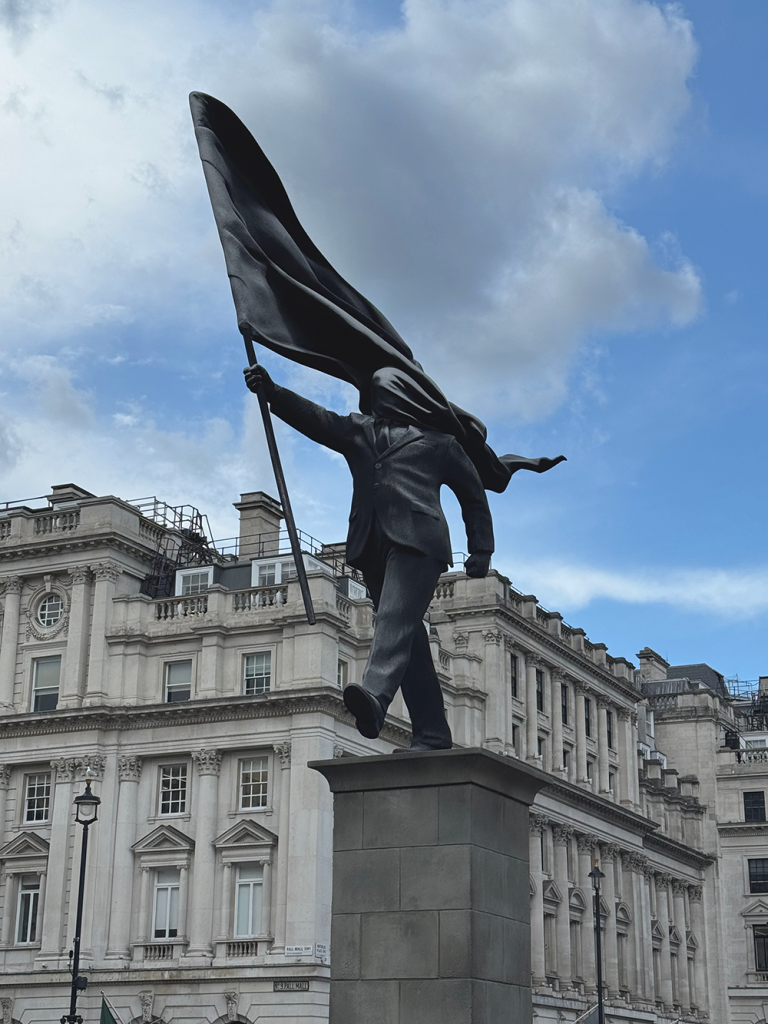
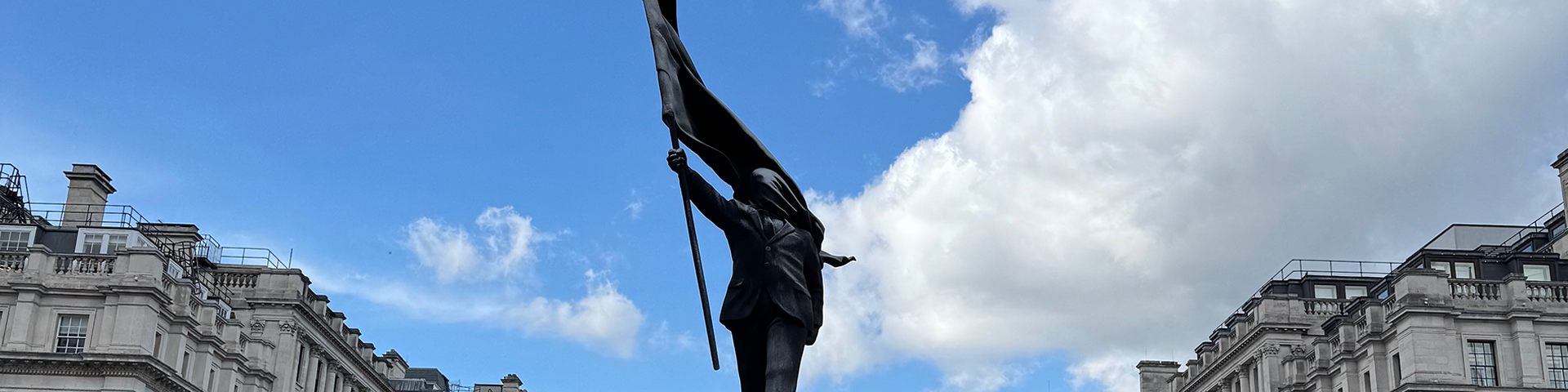
Contrast this example of the flag—the very archetype of the thing which is to be followed—with the recent sculpture attributed to Banksy in which the flag is the thing that obscures with potentially calamitous and somewhat comic effects.
There are some detractors in the comments posted about this latest intervention but overwhelming people responded well to the seemingly effortless communication that this artwork achieves. Far from a bare-breasted goddess of the people, we see a buttoned-up, well-dressed, anonymous, unremarkable man striding determinedly and with conviction. Like Liberty he is in an elevated position, unlike Liberty he is about to lead any followers he may have into a precipitous void.
Just as Delacroix’s painting is tied to current events yet works as a universal example, Banksy’s sculpture resonates with the current situation in the UK and also stands as a warning to the future about the foolishness of a blind commitment to ideology. At the time of writing, there is a renewed preoccupation with the English and Union Flags, exhibited by the right in UK politics through such initiatives as ‘Operation Raise the Colours’ and marches such as the ‘Unite the Kingdom’. The activity of the right is not explicitly referenced in the sculpture—both the kind of flag, and kind of flag bearer, could have been depicted less anonymously. However, the timeliness of the sculpture’s appearance provides at least some licence for the belief that it provides a commentary that has relevance to the use of flags by the populist right in the UK.
Political parties such as Reform have been accused of providing simplistic and unworkable solutions to issues that may previously have lain dormant in the consciousness of sections of the electorate but which they have re-ignited and fomented in recent years. Part of their approach has been to appeal to a certain view of Englishness, and this view can be projected through the prolific use of flags that both claim territory and suggest that there are many among us that support these views—in reality of course the manpower required to raise these flags is vastly disproportionate to the claim for ubiquity that they make. One or two flag-raisers can paint a whole community as supporters of their agenda.
Returning to the idea of a coup, appropriating national flags that belong to the whole population, and attempting to exclusively associate them with a narrower political party or political project suggests a usurping of what it means to be patriotic. And at the same time appropriating the flag in this way provides a shield against criticism since the populist flag-raiser can always claim they are merely declaring their national identity. And even though one may not believe that this is their only motivation, it is difficult to prove that this is not the case.
Another context for the statue concerns where it is located, for it is in a part of London in which many figures from Britain’s colonial past are honoured in statuary. Banksy’s figure stands in stark contrast to these luminaries; not only is he bland and physically unremarkable, but he is comical rather than serious, being recognised for a moment of idiocy rather than for the achievements of an eventful life.
Interestingly, the statue shares several of the attributes presented in Heartfield’s Who Reads Fake News… In both artworks the head of the person depicted is swathed, either by a newspaper or flag. This leads us to infer a number of things; that the wrapped person can probably see very little, and anything they can see is perceived through the filter of the newspapers/flag covering their face. Consequently, if seeing is understanding then their understanding will be severely curtailed by any ideology associated with the newspaper or flag concerned. The wrappings in both cases also remove the individuality and identity of the person concerned suggesting that they are no longer capable of individual independent thought and are now blind followers of some greater hegemonic power.
Where the statue differs from Heartfield’s artwork is in a more explicit suggestion of what is about to happen, or at least what could happen. Once again there are potential mappings at work here from the unnamed individual man who is about to step off the pedestal, to political leaders about to fall from popularity, or to ideologues causing a calamity because of their blind adherence to their beliefs, or to the country as a whole whose misguided patriotism is leading it to an uncertain future.
What makes this statue such an effective piece of communication is that all of these different interpretations do not contradict or cancel each other out, they can synchronise and be self-reinforcing. And this communication occurs without overtly singling out a political party, or section of society and therefore avoids alienation and gives a space for reflection before we retreat into our different echo chambers.