
It seems so simple. There is a photograph of a tree and I can look at it and recognise it as being an image of a tree existing out there in the world. I even happen to know this particular tree on the South Downs close to London.
How many times in a day do we see a visual representation, such as this photo of a tree, and make an association from this, to something out there in the world? As communication designers we might make images and not question the link between the ‘real’ world out there, and an experience of the world provided through a visual image or artefact. Philosophers, psychologists, art historians, and brain scientists have questioned this understanding of course. And there is a term which describes a view of perception—one that corresponds with the idea that an experience of a photograph of a tree simply mirrors an objective reality that exists out there in the real world—that term being naïve realism.
The word ‘naïve carries’ with it a disparaging tone, but in some ways naïve realism just feels like common sense. And in our day-to-day functioning this idea of perceptual experience being a simple mirror of reality might serve us relatively well. So why should designers—and for that matter, photographers, artists, and film-makers—bother about the nuances of representation, reference, and communicative intention?
Representing a tree seems relatively unchallenging, but what about representing an argument, or a brand, a story, an emotion, or an identity? These things would not seem to be things we can point to and represent, in the same way we can point to a tree. It may be nonetheless tempting to think of ideas and emotions as things, like trees, that exist ‘outside’, and independently of us. After all we might not be able to show a quality like love directly but we can show the effects of it on human behaviour, facial expression, or by making associations to things, ‘outside’ that are physical objects that we can see, like a red rose. But this idea of an ‘inside’ and an ‘outside world’ is itself problematic for reasons we will discuss later. So approaching representation as simply the act of holding up a mirror to externally existing things is questioned below.
Some of these difficulties are foregrounded by reflecting on the images below. A juxtaposition of images such as these may well be familiar, whether linked to the sounds takete-maluma (Köhler, 1929) or bouba-kiki (Karthikeyan, Rammairone, Ramachandra, 2016). When Köhler first presented similar word/image pairs to participants, there was nothing that could be pointed to in the world (neither sound nor image) that these pairs were conventionally associated with. They were newly imagined and created for the experiment. Yet nonetheless most respondents unproblematically associate one of these images with one or other of these sounds.
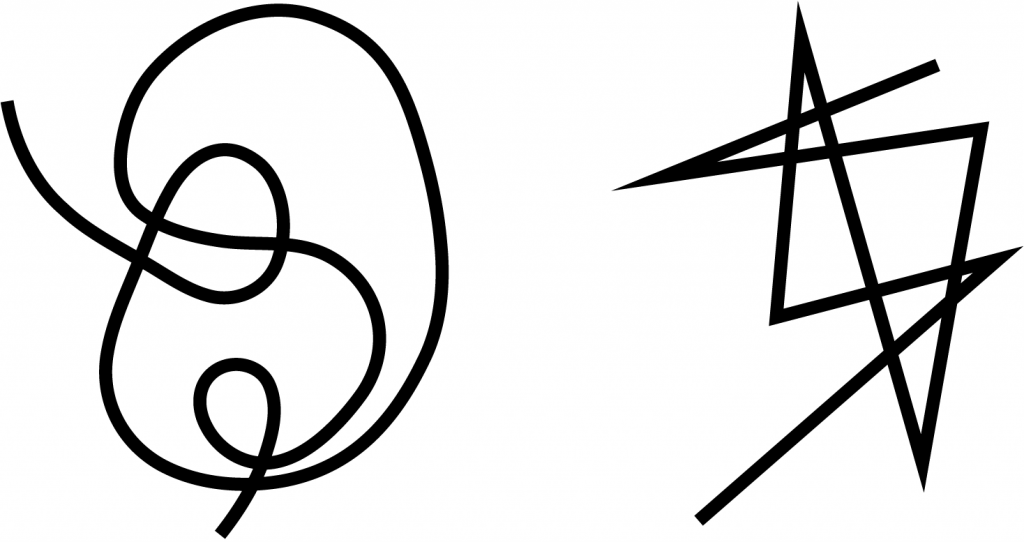
Maluma / bouba, left. Takete / kiki, right.
With regard to our discussion about representation this raises a couple of questions. Firstly, can it be said that ‘maluma’ represents the shape on the left, or conversely that the shape on the left represents the sound ‘maluma’? Secondly, to return to the naïve realist position, when both sound and shape were newly imagined, there was nothing that could be pointed to in the world identical to either sound or shape, so how come there was still something meaningful about these combinations? Indeed over years of showing these sounds and shapes to students, they have been easily able to extend the association, so that one shape or another was consistently paired with concepts (rather than with sounds) such as male (right image) or female (left image), or excited (right image) or relaxed (left image), or quick (right image) or leisurely (left image).
In answer to the first question, it feels like there is a connection between, for example, the shape on the left and ‘maluma’ but it is something of a stretch to say that this shape represents the sound (or vice versa) something extra would seem to be needed before we can use the term representation. What that additional thing is will be explored in the next section where we compare and contrast signification with representation and of the link between form and meaning. Similarly, in relation to the second of these questions, in the sections that follow we will explore how the whole understanding of ‘inside worlds’ and ‘outside worlds’ that underpins naïve realism has been questioned, and suggest that it is better to think of an embodied experience of a tree, or of the sound ‘maluma’, as the thing that is represented, rather than the object or the sound itself.