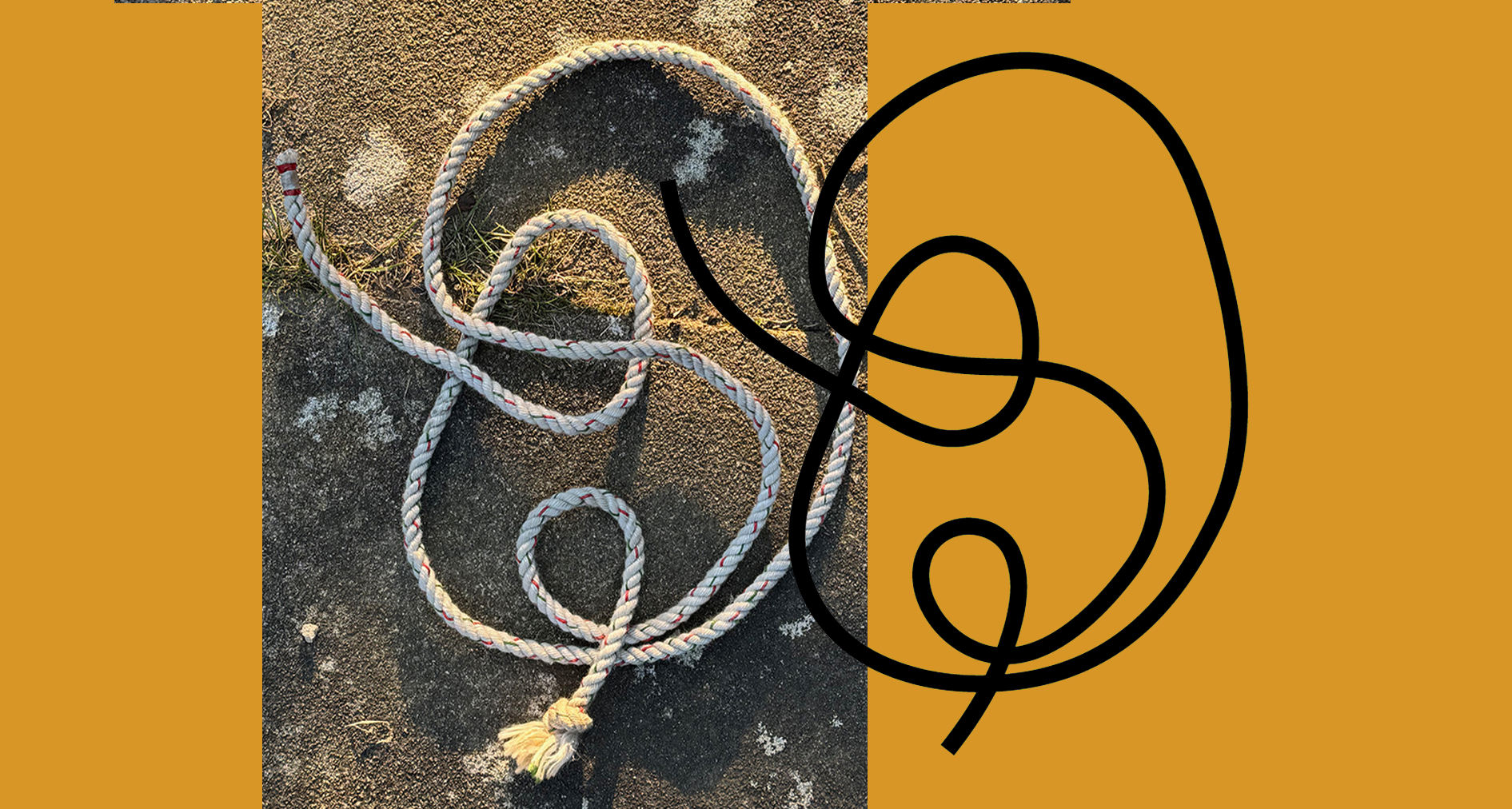
Chris Sinha (1988, p44) distinguishes between signification and representation, and this terminology is useful here. Let’s return to the example of maluma. Below is an image in a green frame, the green frame is important as it is used to indicate that you should imagine the image presented, not as a photograph, but as a scene that you encountered in your travels. In other words you should imagine seeing this directly, without a photographer directing your attention, or even someone accompanying you on your walk pointing the scene out to you. Looking down on your walk you happen to notice this rope on the ground. The simple question is what does this mean? For many of us I would imagine that this means little more than the inference that ‘someone has discarded the rope in this place’ perhaps with the further speculation around what the rope was used for and why it was left in this particular location. It therefore signifies littering or at least the careless placement of unattended ropes in the environment. For those of us familiar with the work of Köhler we might register a resemblance of the rope to the maluma shape, but critically it does not represent this shape unless we conclude that someone left it there with the express purpose of evoking the maluma image (which seems in the circumstances highly unlikely).
Now imagine attending a gallery and finding the need to visit the lavatory (though not necessarily as a response to any of the artworks). Personally, I dislike the escape room levels of code breaking required by some sign systems that denote male and female toilets, but let’s say that the designer of this sign system has a different view. So here is the question: faced by the choice shown in the image below, which door would you choose?
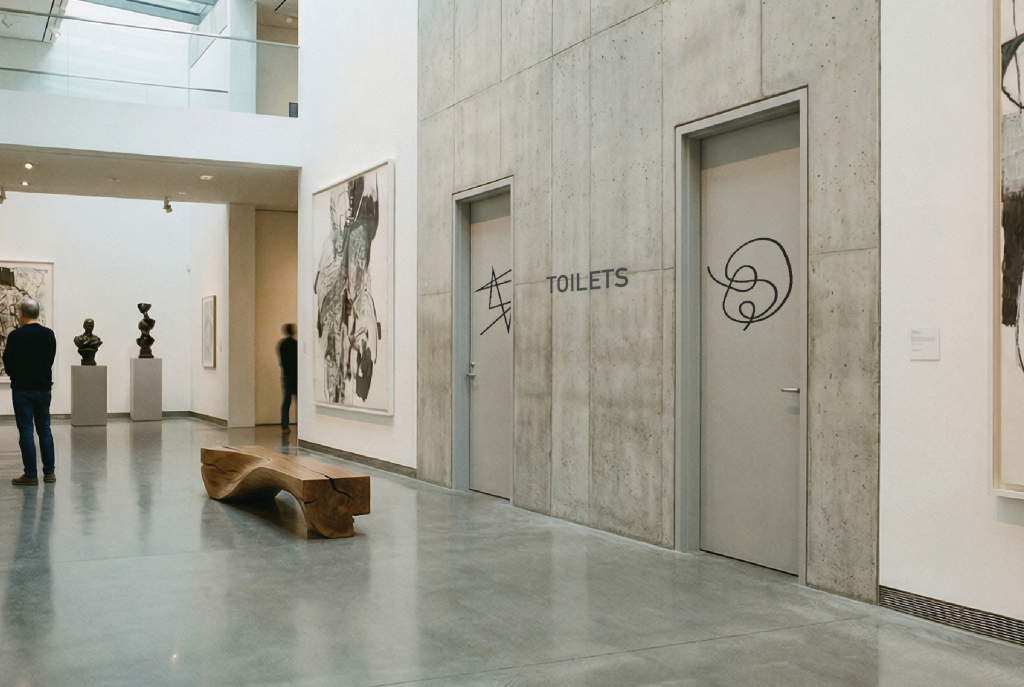
Notice that the maluma shape is a line drawing of the rope in the other photograph, but this time it does represent something, ‘women’. So what has changed? In this situation we can infer that there is a communicative intention, and from our experience of other public buildings we know that toilets are often organised according to the binary choice of ‘women’ or ‘men’. To this existing information, we now have some new information, namely the angular vs curvilinear nature of the lines. How is this relevant—by making an association with the angular physiques stereotypically associated with men and the more curved shapes stereotypically associated with women. It seems reasonably straightforward to conclude that the binary opposition of ‘women’ and ‘men’ aligns with (or in more technical language is isomorphic to) the curvilinear and angular lines in the drawings. In this case therefore it does seem reasonable to say that the maluma shape represents ‘women’. The shape is the form which is paired with the female sex (even though this may be seen as unhelpfully reinforcing stereotypical views about gender).
In Köhler’s original experiment participants were able to associate a form in the visual modality with a form in the auditory modality. We are used to meanings being expressed using different sensory modalities, for example I could utter the sound-form ‘pound’ or simply use the visual-form ‘£’ to evoke the meaning of ‘the unit of currency used in the UK’. What is strange about the sound-form ‘maluma’ and the visual pattern associated with it, is that there is seemingly no explicit meaning to which they both are paired. Yet any form, although it may not evoke sharply defined and deeply entrenched meanings, may still evoke weaker and more ‘fuzzy’ meaningful associations. These forms have what we might call meaning potential. In the case of maluma and its corresponding visual pattern there would seem to be considerable overlap in the fuzzy meaningful associations that they evoke, and this motivates our choice of connecting one visual-form with one sound-form. These same fuzzy meaningful associations also provide structure that can motivate their association with concepts such as ‘relaxed’ or ‘strained’; as well as ‘women’ or ‘man’. And such thinking underpins onomatopoeia as has been recognised in relation to language formation, for example when Köhler says:
In primitive languages one actually finds evidence for the thesis that the names of things and events, which are visually or tactually perceived, have often originated on the basis of such resemblances.
Köhler, 1947, p224
In Köhler’s experiment two previously disassociated forms were seen to resemble each other in a way that enabled observers to connect one with the other. But it is easy to appreciate how quickly these forms can become resources that can be used for representation. The statement ‘maluma, in contrast to takete, is a curvilinear shape made from one continuous line’ involves a jump in that we are now using the sound-form ‘maluma’ to represent the visual pattern. Here, ‘maluma’ is the form that is paired with the meaning that is the specific visual pattern above. Strictly, maluma, as a sound, it is not ‘a curvilinear shape’, but I expect that most readers would be able to make sense of this as a sentence. So long, that is, that they are familiar with the two shapes that correspond to the sounds. In the last section it was suggested that maluma needs something else before it could be said to represent the corresponding shape. In this sentence we are aware of a communicative intention, someone is trying to tell us something about a thing called ‘maluma’, namely that it is a ‘curvilinear shape’. The existence of a communicative intention is therefore an important difference between representation and signification—signification does not require a communicative intention whereas representation does. As Sinha puts it, ‘the logic of representation involves intentionality, whereas that of signification does not’ (Sinha, 1988, p.45). For example, when Robinson Crusoe came across footprints in the sand it signified the existence of another person on the island; it is an inference arising from visual information that he could make based on familiar patterns of association. Man Friday, presumably, is not making these footprints with any communicative intention, therefore although it signifies something, it is not a representation, it is what Sinha terms a motif. There are consequently forms of signification that are not representations even though all representations signify something.
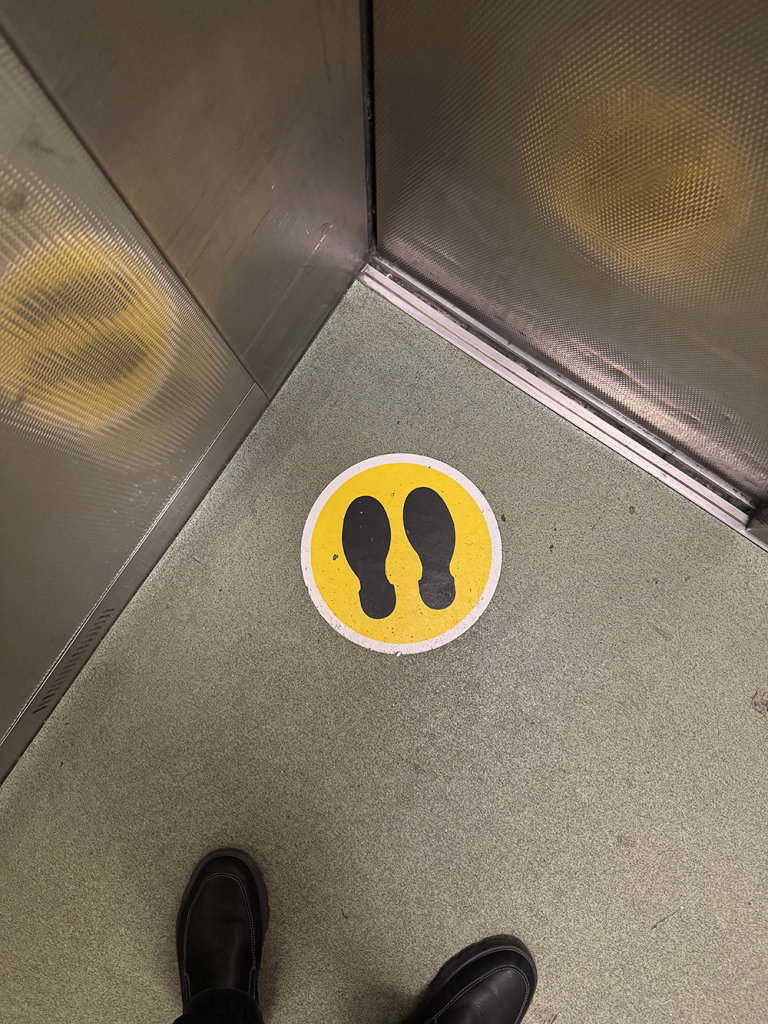
To illustrate the point further, look at the image of the two footprints painted on the ground in the image above. Such images are written across our landscape and are a residue from the COVID era. This image represents footprints, but this representation signifies so much more. We can infer from the context in which these footprints are located—the corner of a hospital lift—that we should stand on these footprints facing away from other people in the lift. These are not traces left in the past by a Man Friday, but an instruction for this moment telling us where we should be standing. Working from the simple assumption that this visual-form represents a meaning; ‘footprint’, we are able to achieve impressive feats (excuse the pun) of reasoning without really thinking about it. Let’s unpack some of the inferences that enable new meaning to emerge:
• the image is an ‘official’ sign, not graffiti, or decoration
• it is placed on the floor rather than the walls of the lift for a reason—this is relevant
• it is possible to align my own feet with image of the footprint, and this will orientate my body in a certain way relative to other users
• lifts are places where users are in close proximity to one another
• I am in a hospital where infection control is an important consideration
• some airborne viruses can spread from one person to another if people are in close proximity
• facing away from other users is probably a good idea as there is less chance of breathing in virus
• this image is a call to action that I am supposed to follow
But then, since most users of the lift simply ignored the sign, we might surmise further reasoning, namely:
• these kinds of signs were frequently encountered at a time when COVID was rife and there was no vaccine, therefore these signs probably date back to that period
• in 2026, COVID is no longer the same threat as it once was, therefore it is safe to ignore these signs
Note that none of this reasoning is explicitly represented by the footprint image, all the visual form has to do is represent the meaning ‘footprint’. The rest is left to the user to work out, particularly, the relevance of why this representation appears in this place. From this sparse beginning we can then postulate what the thinking for this sign was in the mind of the image’s creator. As a designer one might be tempted to not trust the ability of the user to infer meaning in this way. We could easily overload the sign with explanations about what it means and why it is important. Explicitly representing too much information risks reducing the impact of the sign so that it may no longer grab our attention, and it might also become confusing and ambiguous. But on the other hand too little representation, or misconceived representation risks users not being able to recognise the sign’s relevance and make the inferences necessary for them to comply with the actions required. But in the height of COVID I can imagine these signs (there was one of these in each corner of the lift) being effective. The occupancy of the lift was hopefully restricted to no more than four. And hopefully the occupants faced away from each other towards each of the four corners of the lift. A hope which is based on the evaluation that the demands of relevance and impact seem reasonably well balanced here.
Novice designers sometimes assume that they can simply take a form that may be meaningful to them, and then expect everyone else to have access to the same understanding. The footprint image is fairly widely used, and through repeated exposure to this visual form we might expect users to very rapidly recall inferences from the past to arrive at the meaning ‘stand here’. New form-meaning pairings can of course be designated by a designer but these will need to be supported, by a key for example, or by making use of the communicative environment (or usage event to use a term from linguistics) to help the user to infer the meanings intended. The use of the toilet doors above for example support users, hopefully, in differentiating between the forms used to designate ‘women’ and ‘men’.
Another aspect that has to be considered is the attention of the viewer. I will discuss attention at greater length in another essay, however it is worth reflecting here that the viewer might not have chosen to ignore the footprint signs so much as they did not register attentionally. For designers it is easy to assume that a viewer’s attention is distributed across their environment equally; that users are not engaging with the environment intelligently, according to their own specific agenda. If designers subscribe to the view that users focus on things in the environment without prejudice, then making something manifest to attention is simply a job of scaling it up and placing it in the viewer’s eye-line. But attention is much more complex than this. There are different kinds of attention (see Oakley, 2009), and other forms of attention include searching and detection. Back when COVID was more of an issue and there were protocols in place that had to be followed, users would have been searching out for guidance about how to behave, and how to stay safe. So put simply, perhaps these signs were ignored in the lift simply because people were not looking for them, rather than because people processed their meaning and concluded they were no longer relevant.
Accordingly, there is a danger when discussing the representation of a tree or visual pattern that we present an overly mechanical, deterministic view of representation, where a maker’s visual experience gets perfunctorily translated into a form that can be used to represent it. But creating a representation is much more complicated than this, it can require, more, or less, conscious or unconscious effort, it can be more, or less deliberate or accidental, or more, or less habitual or occasional.
We do not exclusively represent perceptual experience either, but also abstract ideas, imagined events, arguments, and so forth. Neither does everything that is in our conscious (phenomenological) experience get captured by a representation of it. Again, the maker of a representation might attempt to highlight or hide some aspects of their experience. They might focus on colour, or on representing the category of tree rather than the specific tree in perceptual experience, they might use lace as a metaphor to suggest the way the light breaks through the tree’s foliage, or use a schematic drawing to highlight the structure of the branches. All of these require the choice of forms appropriate to the representation of different aspects of the maker’s conscious experience—and of course there are a multitude of forms that are available to represent, for example, trees.
Another danger when discussing the representation of a perceptual experience of something like a tree, is that both the experience and/or the representation of it can get collapsed in time to something like a snapshot, which is then fixed and unchanging. Our experience of the tree will involve seeing it from multiple angles, with different lighting effects, and the movement of the branches in the wind. The making of the representation of this experience will involve, decisions about materials and composition, and so forth, and also changes in the maker’s own conscious awareness as the representation is created. New ideas might emerge in the making of the representation which were not there in the initial perceptual or imagined experience. Furthermore, we might want to communicate a lot more about the tree than is practical to do using just one image; the tree in different seasons of the year, for example. In this way our representation can become extended so that it becomes a narrative or an argument.